Applied Behavior Analysis (ABA) has been frequently criticized for creating prompt dependency, and it is often claimed that ABA teaches kids to wait for a cue rather than think for themselves. In reality, ABA does not cause prompt dependency any more than other therapies do.
The real culprit behind the prompt dependency is not the use of prompts!
The real culprit is not teaching initiations!
What is Prompt Dependency, Really?
Prompt dependency occurs when a learner relies on a cue from someone else to start or complete a task, even when he/she has the skill to do it independently. For example, they don’t brush their teeth until you say, “Brush your teeth!” They don’t start their homework until you point to the table. They don’t ask for a drink until you hold up the cup and say, “What do you want?”
This may look like a lack of motivation or learned helplessness, but in most cases, it’s simply what it was taught. The learner has been systematically and exclusively taught that their role is to respond, not to initiate. Lack of initiation is equated with prompt dependency even though interventions have not specifically targeted initiation as an acquisition skill. This type of rationale assumes that teaching someone to do something will automatically teach them when and how to do it on their own; it mistakes the ability to respond with the desire to initiate. For example, it assumes that if you can answer a question, you’ll automatically know when to ask one. These skills are completely different and require different methods to teach.
The Scapegoat: Prompts Are Not the Enemy
Let’s be clear: Prompts are essential. They are the helpful hints, the physical guides, and the visual supports that bridge the gap between not knowing how to do something and doing it independently.
Think about learning to drive a car. Your instructor didn’t just sit silently and expect you to know everything. They prompted you: “Check your mirror,” “Ease off the clutch,” “Turn on your signal.” These prompts were faded over time until you could drive on your own. The prompts were a tool, not a crutch.
In ABA, prompts are designed to be temporary. The goal is always to fade them out systematically. It is important for clinicians and parents to know that every prompt should be implemented with a plan to fade it out. A skill is considered mastered only when it is emitted in the absence of all prompts. The problem arises when the fading plan is poorly executed, or worse, non-existent.
The Real Root Cause: Not Targeting Initiations
This is the core of the issue! Generally, therapy sessions focus on a “stimulus-response” model where the therapist presents an instruction (the stimulus), and the child responds. It is the nature of teaching any skill! In any discipline!
While this teaches valuable skills, if it’s the primary mode of instruction, we are only teaching the child to be an excellent responder. We are not teaching them to be an initiator—to be the one who starts the interaction, to communicate a need without being asked, to solve a problem they encounter on their own. Initiations are learner led and, by nature, occur in the absence of the partner’s effort/intention to generate a behavior from the learner. Initiations require the ability to assess the environment, select a potential listener/interaction partner, approach or orient towards the partner, evaluate the context, emit a statement that is appropriate for the context and for the listener. Initiations are an extraordinarily complex set of behaviors that include both verbal and nonverbal components and are under the learner’s exclusive control.
Considering the complexity of initiations, we cannot expect them to ‘appear’ just because we’ve taught responses; this misconception holds back both the learner and the clinician.
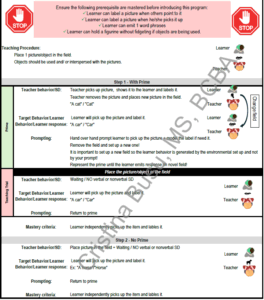
Initiations need to be addressed through programming as a separate set of skills. Shifting the focus requires intentionality. It means creating programming for initiations, teaching the learner how to use mastered skills to initiate simple and complex tasks, interactions, and conversations.
Initiations go beyond requesting for items that a learner needs. One of the first skills kids engage in to initiate an interaction is showing off a toy or an item to the caregiver or adult.